EBC Compliance
A comprehensive guide on biochar certification and why it matters.
The growing need for
quality biochar
Scale. Quality. Expertise.
With rising challenges in soil degradation, water retention, and carbon sequestration, biochar has become essential for agriculture, horticulture, landscaping, and climate change mitigation in the UK. Meeting this demand requires scalable production, consistent quality, and adherence to strict certification standards.
Why certification?
Certifications guarantee that the biochar meets strict environmental and performance standards. They serve as industry benchmarks, ensuring biochar is sustainable, contaminant-free, and effective. For users and businesses, certifications provide trust and quality assurance while confirming climate-positive impacts.
The European Biochar Certificate (EBC) is one of the leading standards for biochar quality and sustainability. Onnu Biochar proudly meets these stringent requirements, ensuring our products are safe, effective, and environmentally responsible.
European Biochar
Certificate
The European Biochar Certificate (EBC) is the benchmark for high-quality, sustainable biochar production. It establishes strict guidelines for safety, performance, and environmental impact, ensuring that biochar delivers measurable benefits for soil health, carbon sequestration, and sustainability.
The EBC was established to provide customers with a trusted quality standard and to enable producers to demonstrate that their biochar meets clearly defined and widely recognized benchmarks. Its guidelines aim to promote and ensure the controlled production of biochar through processes that are scientifically validated, legally compliant, economically feasible, and practically effective.
Facts, eligibility, applications.
All about EBC
Criteria
The EBC examines several physical and chemical properties of biochar to certify and classify biochar. Some of these include total and organic carbon content, H/C ratio, water content, presence of heavy metals, nutrient levels, pH, salt content, bulk density, presence of organic contaminants, etc.
Certification Classes
To accommodate the expanding applications of biochar, the EBC has established certification classes as follows:
- EBC-BasicMaterials: Introduced as the basic and fundamental certification class that defines what can or cannot be considered as biochar.
- EBC-ConsumerMaterials: For biochar to be used in products that may come into direct skin contact with consumers or food-grade products.
- EBC-Urban: For use in tree planting, park maintenance, sidewalk embellishments, ornamental plants, and rainwater drainage and filtration.
- EBC-Agro: For use in conventional agricultural practices, focusing on improving soil health, enhancing crop productivity, and contributing to sustainable farming systems.
- EBC-AgroOrganic: Specifically designed for use in organic farming systems, this certification ensures that the biochar meets stringent quality and safety standards suitable for organic agricultural practices.
- EBC-Feed: Specifically designed for biochar intended as an additive in animal feed. It meets equally all requirements of the EU feed regulation but not those of the EU fertilizer product regulation.
- EBC-FeedPlus: Highest standard system for biochar intended as an additive in animal feed. It meets all EU and EFTA regulations relevant for animal feeding and agricultural soil applications. It can be used for all livestock operations and also be applied to soil.
2012
Ithaka Institute
Carbon Standards International (CSI)
What's the difference?
Switzerland
3
What makes good biochar?
EBC is thus the 'gold standard' for biochar certification. But what else makes 'good biochar'?
The biochar properties depend heavily on the feedstock and the pyrolysis process conditions involved. A feedstock's physical and chemical properties play a vital role in deciding the properties of biochar that will be produced. Some of the key properties include:

In general being over 12 MJ/kg on a dry basis will keep the production process self-sustaining. Any more than that can be used to dry feedstock or generate green energy.

The more fixed carbon, the more will be sequestered in the biochar, generating carbon credits. Usually, upwards of 25% is a good figure.

Different feedstocks will deliver different amounts of biochar for every tonne of feedstock. Typically, high volatile matter will convert to energy, making less biochar.

A wet feedstock requires significant energy to bring the moisture content down to the required 15%, which can usually be powered from green energy from the pyrolysis process.
Interested in buying biochar?
Improve soil fertility, strengthen low-carbon concrete, enhance filtration and remediation, or support animal health with our premium biochar.

Feedstock source
& end-of-life treatment
As an environmentally positive solution, it is important to consider the current uses of the biomass.
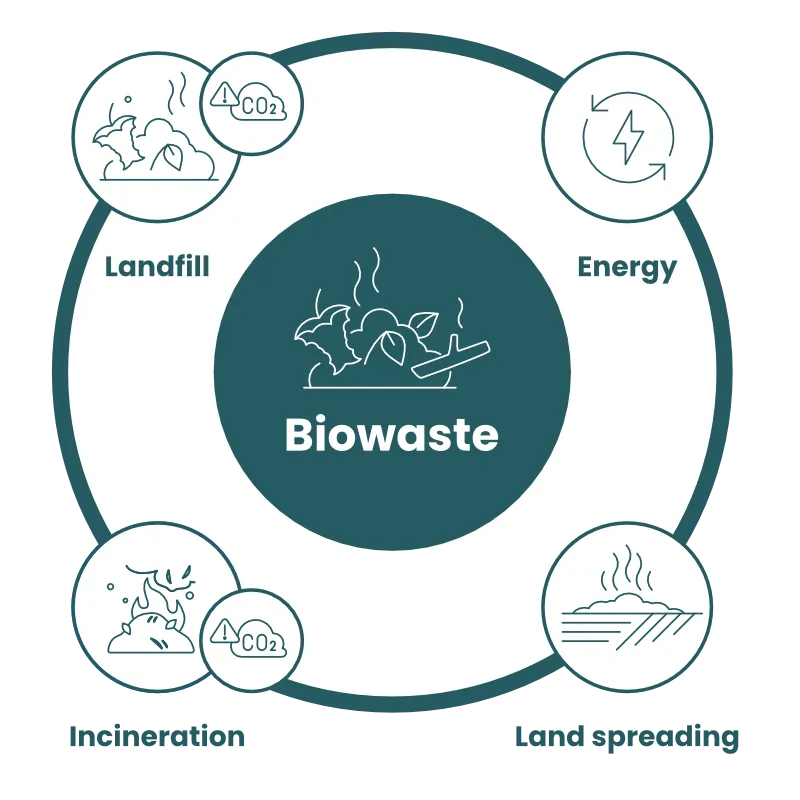
Ideal sources of biomass are those that are currently destined for disposal or incineration. Using these ensures that we don't have any negative environmental, social or economic impacts on existing supply chains. Biomass containing high protein, for example, may deliver more value if it returned to the food chain.
As a company that firmly believes in the principle of Triple Bottom Line (Planet, People, Profit), this choice ensures that we support profitable projects without doing injustice to the planet and its people.
Why choose Onnu Bioflow as your
biochar supplier?
From achieving EBC certification to ensuring Puro compliance, every step of our process reflects our dedication to excellence and environmental responsibility. Our expertise in biochar production, paired with the use of carefully selected sustainable feedstocks, enable us to create products that are both effective and eco-friendly. With the scale to meet diverse needs and the multi-purpose functionality to serve various applications, Onnu Bioflow is a trusted solution for enhancing soil health while supporting sustainable practices.

Onnu Bioflow meets the rigorous standards of the European Biochar Certificate (EBC), ensuring top-tier quality, safety, and sustainability in every product.

Our scalable production capacity enable us to meet the growing demand for biochar in the UK for both household and commercial scales.

Choosing sustainably sourced waste biomass that meets the quality criteria enables us to produce high quality biochar that is climate positive too.

Our production sites are compliant with Puro.earth’s carbon removal standards, verifying its production quality effectiveness in sequestering carbon.

Our team combines scientific knowledge, industry experience, and cutting-edge technology to produce biochar that meets the highest standards.

Our biochar products and blends are designed to excel across a range of applications, from improving soil health and composting to water filtration and urban landscaping.